Joann Barber had always considered herself responsible about her health.
Barber, a retired employee and Baltimore resident stayed consistent with annual mammograms for years, even after dealing with fibroids and multiple surgeries earlier in life.
Because those earlier health scares had always turned out manageable, she believed there was little reason to panic when doctors called her back after a routine mammogram around 2016 or 2017.
At first, the callback felt more like an inconvenience than a warning sign. Barber assumed doctors were simply being extra cautious because of her medical history. She delayed returning for additional imaging and convinced herself that nothing serious could suddenly appear after years of normal screenings.
“To be honest with you, I really can’t say that I felt something wasn’t right,” Barber said. “I had been fibrocystic for years, starting in my mid-20s, and I had several surgeries to remove fibroids. After a while, they stopped coming back, so I thought everything was fine.”
When Barber finally returned for additional testing, the atmosphere immediately felt different. Technicians instructed her not to get dressed after the mammogram because the radiologist needed to speak with her directly. Even then, she convinced herself there had been some sort of mistake.
Barber later received a call from an oncologist’s office requesting an appointment, but she still struggled to accept the possibility that the abnormal findings involved cancer. Her earlier experiences with fibroids had conditioned her to believe breast abnormalities were manageable and unlikely to become life-threatening.
After surgery, doctors informed her the cancer had progressed from stage one to stage two. Barber said that moment finally forced her to confront the seriousness of the diagnosis and the emotional impact of delaying follow-up care.
“But after the mastectomy, when they told me I was stage two instead of stage one, that’s when I broke down emotionally,” Barber said. “I didn’t understand how it had progressed.”
The Spokesman is examining the effect of cancer on the Morgan community, from the student body to faculty, staff, administrators, and alumni in its Black Health Matters: Cancer on Campus series.
Barber’s experience reflects a larger issue researchers and physicians say continues to affect Black women diagnosed with breast cancer.
Delayed diagnoses can happen for many reasons. Some women avoid follow-up care because of fear or denial, while others face barriers involving healthcare access, financial pressure or poor communication from providers. Researchers say those delays can worsen outcomes, particularly for Black women who are more likely to develop aggressive forms of breast cancer.
Valerie Odero-Marah, executive director of Morgan State University’s Center for Health Disparities Research and Innovation, said social and economic factors often shape whether women seek preventative care consistently.
She said missing work, lacking insurance coverage and mistrust of healthcare systems can all contribute to delayed diagnoses in Black communities. Many women are balancing jobs, caregiving responsibilities and financial obligations that make preventative healthcare difficult to prioritize.
“Delayed diagnosis could be caused by a couple of things,” said Odero-Marah, a professor of biological sciences at Morgan. “Mostly, there’s disparity maybe in income, so social determinants of health. Lack of insurance could be a major factor because it costs money to do the yearly check-up if you don’t have insurance.”
Odero-Marah also said denial is common, especially when women do not immediately feel sick or experience pain. Some women avoid screenings because they fear receiving life-changing news, while others question the need for appointments if they feel healthy.
“People also don’t want to miss work,” Odero-Marah said. “Many people live paycheck to paycheck, so if you miss a day of work, you miss that income.”
Researchers have also found that Black women are more likely to develop aggressive forms of breast cancer at younger ages. Odero-Marah said triple-negative breast cancer, one of the most aggressive types, disproportionately affects Black women and is often more difficult to treat.
“In breast cancer research, it’s well known that Black women get the more aggressive kind,” Odero-Marah said. “The most aggressive kind is called triple-negative breast cancer, and Black women seem to get it at a younger age than white women.”
For some women, delays happened even after seeking medical attention.
Janet Cooper, a 76-year-old home and hospital teacher from West Baltimore, said she knew something felt wrong months before receiving an official diagnosis.
In August 2021, Cooper noticed discharge from her breast and immediately became concerned. Because she could not get an appointment with her doctor until October, she went to the emergency room hoping for answers.
Even after receiving mammograms and ultrasounds later that year, Cooper said communication from providers remained limited and frustrating. Weeks passed without clear explanations about the suspicious findings or next steps.
“I had noticed discharge from my breast in August of 2021, and because I could not get an appointment with my doctor until October, I actually went to the emergency room because I felt uneasy about it,” Cooper said.
Cooper said the delays and lack of communication created anxiety and uncertainty throughout the process. She worried because nobody clearly explained what the scans showed or how quickly she needed additional care.
She was officially diagnosed with stage one breast cancer in March 2022. The experience changed the way she approaches healthcare and taught her the importance of self-advocacy, especially for Black women navigating complicated medical systems.
“You cannot just assume that no news means everything is okay,” Cooper said. “You have to ask questions, follow up, and make sure you are getting answers.”
Dr. Shana Ntiri, assistant director of the Community Outreach and Engagement Program at the University of Maryland Greenebaum Comprehensive Cancer Center, said stories involving delayed diagnoses and communication barriers are not uncommon.
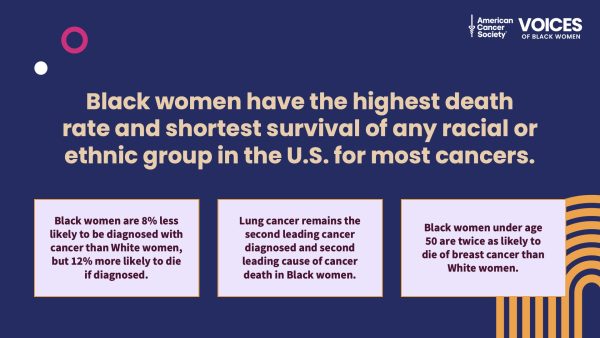
Ntiri said African American women continue to face worse breast cancer outcomes despite white women being diagnosed more frequently overall. Researchers have connected those disparities to screening gaps, healthcare access, medical mistrust and delayed follow-up care.
“White women are diagnosed with breast cancer more often than African American women, but African American women die from breast cancer at higher rates — sometimes as much as 40% higher than white women,” said Ntiri, an associate professor of family and community medicine at the University of Maryland School of Medicine.
She said timing often determines survival outcomes. Women diagnosed at earlier stages generally have far better treatment outcomes than patients whose cancer is discovered later. Fear, however, can prevent some women from returning after abnormal mammograms or suspicious screenings.
Ntiri, an occasional spokesperson for the American Cancer Society, said some patients delay care because they are overwhelmed by the possibility of receiving a cancer diagnosis, while others struggle to access follow-up appointments quickly enough. Those delays can allow cancer to progress before treatment begins.
“One issue is when people enter the healthcare system,” Ntiri said. “Are they getting screened at the same rates? Are they being diagnosed at the same stage? Earlier diagnoses lead to better outcomes.”
Both physicians emphasized the importance of yearly screenings, self-exams and patient advocacy.
Odero-Marah said many women are unfamiliar with the importance of regularly checking for changes in their own bodies. Without self-exams, she said, women may miss warning signs or fail to recognize abnormalities early enough for quicker treatment.
“I don’t think women, as women, do enough self-examination,” Odero-Marah said. “You have to do self-exams all the time so you know the texture of your breasts. If you don’t do that, you won’t know there’s something wrong.”
Both Cooper and Barber said surviving breast cancer changed how they now approach their health.
Cooper said she keeps every appointment and remains proactive with follow-up care, while Barber said the experience taught her not to ignore medical concerns out of fear or exhaustion. She now encourages other women to seek care quickly, even when the possibility of bad news feels overwhelming.
This student’s story is the product of a semester-long reporting project from the MMJN 350 class of the Multimedia Journalism department of the School of Global Journalism and Communication.